Stop Reeling In and Start Catching: The Case for Slowing Down Your Casting Game
There's a particular kind of angler you've probably seen — or maybe been — on the water. Rod in constant motion, lure barely touching the surface before it's whipped back overhead, covering water like they're racing a clock. It looks productive. It feels productive. And it is, in fact, one of the most reliable ways to come home empty-handed.
Here's the uncomfortable truth that experienced anglers eventually stumble onto: casting more often doesn't catch more fish. In a lot of situations, it actively prevents it. The counterintuitive reality is that slowing down — holding your position, letting your lure do its thing, resisting every instinct to reel in and try again — consistently outperforms high-volume, high-movement approaches across a wide range of species and water types.
Let's talk about why.
Fish Don't Feed on Your Schedule
One of the biggest mental errors recreational anglers make is assuming fish are either biting or they're not — and if they're not biting right now, it's time to move. But feeding behavior is far more nuanced than that binary.
Research into fish feeding cycles shows that most species operate in short, concentrated windows of active feeding separated by longer stretches of relative inactivity. Bass, walleye, trout, redfish — they all follow this pattern to varying degrees. During those inactive windows, a fish isn't ignoring your lure because it's the wrong color or the wrong size. It's ignoring your lure because it's not hungry right now.
Here's the kicker: if you're constantly casting and retrieving, you're pulling that presentation away from fish before those brief feeding windows even open. You might have dropped the perfect bait two feet from a suspended largemouth — and then yanked it back before the fish had a reason to commit.
Patience isn't just a virtue on the water. It's a tactical advantage.
The Anxiety Loop That Kills Catches
There's a psychological component here that doesn't get discussed nearly enough. Angler anxiety — that creeping restlessness when nothing's happening — drives an enormous amount of counterproductive behavior. We move spots too early. We switch lures before giving any single presentation a fair run. And we cast again before the previous cast has had time to work.
This isn't a character flaw; it's a completely natural response to uncertainty. Standing still while nothing seems to be happening feels like wasted time. But that perception is almost always wrong.
The anglers who consistently put fish in the boat — not just occasionally, but reliably — have typically learned to reframe stillness. Instead of reading a quiet rod as "nothing is here," they read it as "I haven't triggered the right moment yet." That mental shift is genuinely game-changing.
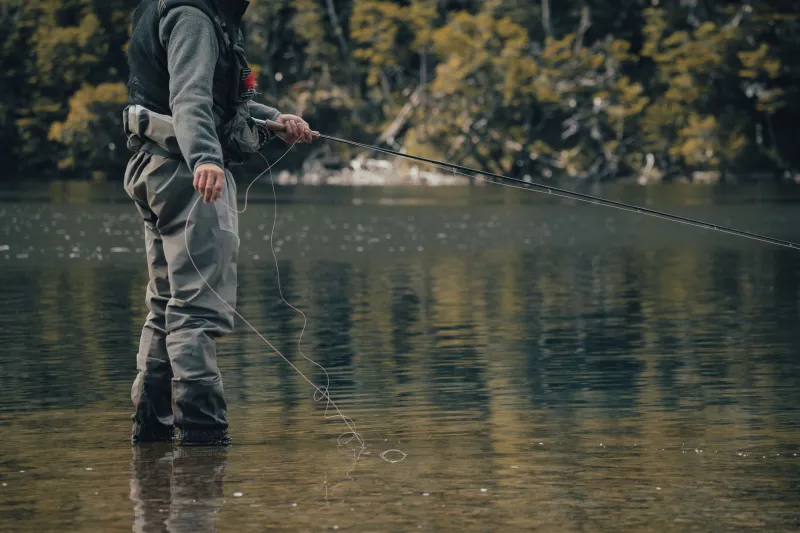
If you've ever watched a fly fisherman work a pool on a trout stream, you've seen this principle in action. They'll make a cast, mend the line, track the drift, and wait — sometimes for what feels like an uncomfortably long time — before picking up and casting again. That's not indecision. That's confidence.
When to Hold and When to Move
This isn't an argument for never moving. Covering water absolutely matters, especially when you're on an unfamiliar body of water or targeting suspended fish. The point is that most anglers move too early, not too late.
A useful rule of thumb: give any productive-looking piece of structure at least three to five well-executed presentations before writing it off. And by well-executed, that means the lure is reaching the right depth, hitting the right zone, and staying there long enough for a fish to make a decision.
For bottom-contact baits — soft plastics, jigs, drop shots — this is especially critical. A Texas-rigged worm that sits motionless on the bottom for four or five seconds after it lands is doing more work than most anglers realize. That subtle pause mimics a real creature that just hit the bottom and is momentarily stunned. Bass, in particular, absolutely hammer baits during that dead-still moment. If you're already twitching the rod tip the second the bait touches down, you're skipping the most productive part of the retrieve.
Species That Reward the Wait
Some fish are more forgiving of impatience than others, but across the board, slower presentations tend to produce bigger, more quality fish.
Bass — Both largemouth and smallmouth respond extremely well to extended pauses on soft plastics and jigs. Tournament pros have known for years that a bait sitting still in the strike zone longer than feels comfortable is usually doing its best work.
Walleye — Notorious for light, almost imperceptible strikes, walleye often need time to fully commit to a presentation. Slow jigging with extended pauses between hops is a staple technique on waters from Lake Erie to Mille Lacs.
Redfish — In shallow flats situations, sight-fishing for redfish is a masterclass in patience. Bombing a cast right on top of a tailing red spooks it every time. The play is to lead the fish, let the bait settle, and wait for it to come to you.
Trout — Whether you're nymphing or throwing spinners in a mountain stream, trout that have been pressured (which in most US public water, they have) are notoriously selective. A drifted nymph that hangs in the strike zone for an extra beat consistently outperforms one that's rushed through.
Practical Ways to Build Patience Into Your Approach
Knowing patience is valuable and actually practicing it are two different things. A few techniques that help:
Count it down. After your bait lands, count silently before doing anything with it. Start with a five-count and work up to ten. You'll be surprised how often the strike comes during that window.
Use gear that rewards patience. Finesse setups — lighter line, smaller hooks, natural-looking soft baits — tend to perform better when given time to work. If your gear is built for speed, you'll naturally fish fast.
Fish structure, not water. Covering water quickly makes sense in open, featureless environments. But when you're fishing a laydown, a dock, a rock pile, or a weed edge, slow down and work every angle of that structure before moving on.
Keep a log. Track how long you stayed in each spot and what happened. Patterns will emerge, and you'll quickly notice that your most productive sessions tend to involve longer dwell times in fewer locations.
The Bottom Line
Fishing is one of those rare pursuits where doing less — deliberately, strategically — is often the path to doing better. The instinct to stay in motion, to keep casting, to cover more water, is understandable. But it's worth questioning every time you hit the water.
Next time your rod goes quiet, resist the urge to immediately reel in and try again. Give that presentation a little more time. Let the fish find it. Trust that the water isn't empty just because it's silent.
More often than not, the bite is coming. You just have to be still long enough to be there when it does.