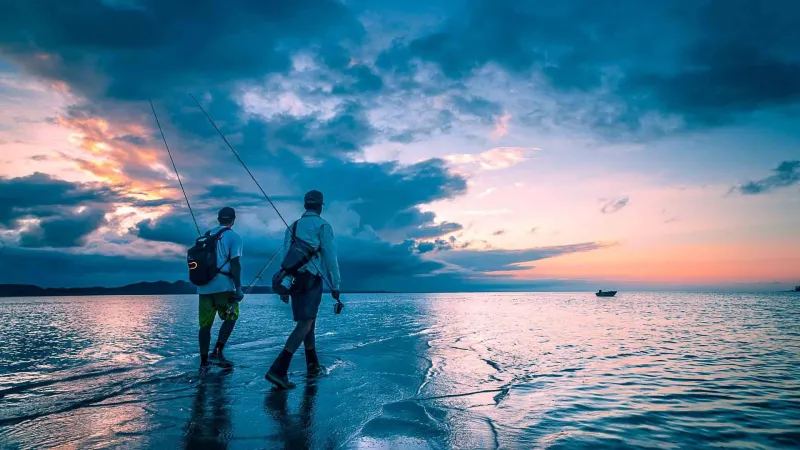
Your Tackle Box Is Lying to You: A Month-by-Month Guide to Fishing Smarter All Year Long
Photo: Betty Longbottom , CC BY-SA 2.0, via Wikimedia Commons
There's a version of this story that plays out on boat ramps all across the country, every single year. An angler loads up with the same spinnerbaits that crushed it in late summer, heads out in early November, and comes home with a cooler full of nothing but cold air. They chalk it up to bad luck, maybe a slow bite, maybe the moon phase. But here's the uncomfortable truth: the fish were there. The angler just wasn't speaking their language anymore.
Seasonal tackle adaptation isn't a secret held by tournament pros. It's a discipline — one that pays off in more hookups, more landed fish, and a lot fewer days where you're blaming the weather.
Why Fish Don't Care About Your Favorite Lure
Fish are cold-blooded, which means water temperature drives almost every decision they make — where they hold, how aggressively they feed, and what they're willing to eat. When water temps drop below 50°F, bass metabolism slows dramatically. They're not going to chase a fast-moving crankbait across a flat. But a lot of anglers keep throwing exactly that, because it worked in August.
The mismatch between angler habit and fish behavior is the single biggest reason most people plateau in their catch rates. Once you start thinking of your tackle box as a seasonal wardrobe rather than a permanent collection, everything changes.
Winter (December–February): Slow Down and Go Deep
Winter is where impatience gets punished hardest. Fish are lethargic, hugging structure in deeper water where temperatures are slightly more stable. Your presentation needs to match that energy — or lack of it.
What to reach for: Finesse rigs dominate this window. Drop shots, shaky heads, and small ned rigs in natural colors (green pumpkin, brown, black) are workhorses. For walleye anglers, slow-rolled blade baits near rocky bottom transitions produce when nothing else will.
What to ditch: High-speed retrieves and noisy topwater. You're not triggering reaction strikes when a fish's metabolism is running at 30% capacity.
Checklist: Downsize your line, slow your retrieve to a crawl, and target the deepest structure you can find. Patience isn't optional here — it's the technique.
Spring (March–May): Match the Spawn Energy
This is the season most anglers get right, at least partially. Pre-spawn and spawn periods are when fish are aggressive, shallow, and feeding hard to fuel reproduction. But there's a window before the spawn — often overlooked — where fish are staging and highly catchable with the right approach.
What to reach for: As water temps climb through the 50s, start working reaction baits like jerkbaits and lipless crankbaits over transitional structure — points, humps, and the edges of flats. Once temps hit the low 60s and fish move shallow to bed, soft plastics and jigs near visible cover become money.
What to ditch: Deep finesse setups from winter. Fish are moving up, and your presentation needs to follow them.
Checklist: Watch your water temp religiously. A 3–4 degree rise can shift fish behavior overnight. Keep a jerkbait and a soft plastic stickbait rigged and ready to swap based on what the fish tell you.
Summer (June–August): Think Early, Think Deep, Think Shade
Summer separates the casual angler from the committed one. The window for active feeding compresses to early morning and late evening. Midday fish are seeking shade, depth, or current — sometimes all three.
What to reach for: Topwater early in the morning — poppers, frogs over matted vegetation, walking baits along shaded banks. Once the sun climbs, go deep with Texas-rigged creature baits, football jigs, or Carolina rigs dragged over offshore humps.
What to ditch: The expectation that fish will cooperate at 2 p.m. in August. They won't. Adjust your schedule, not just your tackle.
Checklist: Set your alarm. The best summer fishing often happens in a two-hour window before most people have finished their coffee. Have a topwater rig and a deep-water setup ready to go before you leave the truck.
Fall (September–November): The Feeding Frenzy You're Probably Missing
Fall is arguably the most underrated season among recreational anglers, and that's a shame — because it can be the most productive of the year. Fish sense the shortening days and dropping temps and go on a pre-winter feeding binge. Baitfish school up in massive numbers, and predators follow.
What to reach for: Match the hatch on baitfish size and color. Shad-pattern crankbaits, swimbaits, and lipless rattletraps in chrome or white/chartreuse can absolutely hammer fish when bait is schooling. Watch for birds working the surface — that's often your best sonar.
What to ditch: Slow finesse presentations, at least early in the fall. Fish are chasing, and you want to be in the chase.
Checklist: Keep an eye on water temperature as fall progresses. Once temps dip below 55°F, begin transitioning back toward slower, deeper presentations. Fall isn't one uniform season — it's a sliding scale, and the best anglers adjust as it moves.
The Gear Rotation Habit That Changes Everything
Here's a practical system worth building: at the start of each season, pull everything out of your tackle box and physically set aside what doesn't fit the upcoming conditions. Store it. You'll be less tempted to default to old habits if the lure isn't sitting right in front of you.
Then build a short seasonal kit — five to seven proven setups that match current water temps, prey behavior, and fish metabolism. Keep that kit lean and accessible. Switching your strategy doesn't mean buying more gear. It means using what you have at the right time.
The Bottom Line
Fish are predictable. That's actually good news. It means if you're not catching them, the problem is solvable — and it usually starts with your tackle strategy being stuck in the wrong month. Start reading the water temperature, think about what the baitfish are doing, and let that drive your rig selection instead of habit.
Cast further, fish smarter — and let the calendar be your guide.