Other Boats Don't Mean Bad Fishing: How to Outsmart Pressure and Own Any Spot on the Water
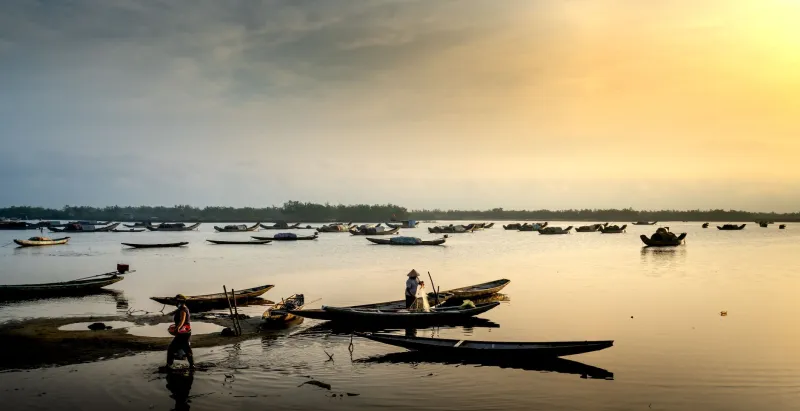
There's a moment every angler knows. You're running toward a promising point, coffee still warm in the cupholder, and you round the bend to find two boats already parked right where you planned to fish. Most guys throttle up and move on. Maybe they grumble a little. Maybe they spend the next hour hunting for something "untouched."
Here's the thing: that instinct to flee is costing you fish.
Fishing pressure is real. But the way most anglers interpret it — as a hard stop, a dead zone, a reason to keep running — is flat-out wrong. The anglers who consistently fill the livewell on busy weekends aren't finding secret spots. They're thinking about pressure differently than everyone else.
Not All Pressure Is the Same — And That Distinction Is Everything
Before you can work around pressure, you have to understand what kind you're dealing with. There are three main types, and they affect fish behavior in completely different ways.
Time-of-day pressure is the most temporary. A dock that had three kayaks tied up at 7 a.m. might be completely dead by 9. Fish that got spooked or went lockjaw from early activity often recover within 45 minutes to a couple hours. If you're marking fish on your electronics in a spot that's been recently vacated, don't assume the window is closed — it might just be cracking back open.
Competition pressure is what happens when multiple anglers are actively working the same area in real time. This is the most visible form, and it triggers that "leave" reflex. But competition pressure often tells you something crucial: the fish are there. Nobody parks a boat for two hours in a spot with nothing going on. When you see two or three rigs anchored or slow-trolling the same stretch, that's not a red flag — that's confirmation.
Seasonal pressure is the slow burn. A well-known spawning flat that gets hammered every spring, a popular channel edge that every tournament angler in a 50-mile radius already knows about — this kind of pressure changes fish behavior at a deeper level. Bass and walleye in heavily fished systems learn patterns. They become what guides call "educated" fish. This is the pressure that actually demands the most creative response.
What Other Anglers Are Telling You Without Opening Their Mouths
Spend five minutes watching how other fishermen are working a spot before you decide what to do next. You'll learn more than you'd get from an hour of blind casting.
If everyone's working the main point and nobody's catching, the fish have almost certainly moved off the primary structure. Look for the secondary spot — the submerged rock pile 40 yards back, the subtle depth change just off the edge of where everyone's focused. Under pressure, fish compress into the nearest available refuge. They don't go far. They just go somewhere slightly less obvious.
Watch their retrieve speeds. If the guy in the next boat is burning a spinnerbait and coming up empty, that's useful data. Try the opposite. Slow it way down. Dead-stick a soft plastic. Let it sit so long it feels almost rude. Pressured fish have seen fast-moving lures all morning — a bait that just hangs there, doing nothing, can be exactly the trigger that breaks through.
Also pay attention to angles. Most anglers cast parallel to the bank or straight out from where they're standing. If you can reposition to throw at a completely different angle — casting from deep water toward shallow, or approaching the structure from the back side — you're presenting your lure to fish that may not have seen anything come from that direction all day.
The Unconventional Presentations That Actually Work on Educated Fish
When the standard playbook has already been run, you need to go off-script. Here are a few moves that consistently produce on pressured water.
Downsize everything. This is probably the most reliable adjustment in tough-bite conditions. If everyone's throwing 3/4-oz jigs, drop to 3/16. Swap your 5-inch stick bait for a 3-inch version in a more natural color. Pressured fish are suspicious of anything that looks like what they've already seen. Smaller, more subtle presentations don't just look different — they behave differently in the water, often triggering reaction strikes from fish that have refused everything else.
Change your cadence, not just your lure. Anglers tend to reach for a different bait when they're not getting bit. Sometimes the smarter move is to fish the same bait in a completely different rhythm. A jig that's been hopped aggressively all morning might get inhaled if you switch to a slow, dragging retrieve with long pauses. Fish that are pressured and lock-jawed often need the bait to come to them rather than flash past.
Go finesse when everyone else is power fishing — and vice versa. On lakes where the weekend crowd is throwing drop shots and ned rigs, sometimes a big, loud, fast-moving swimbait pulls a reaction bite from a fish that's been ignoring finesse presentations all day. The opposite is equally true: on a lake full of guys throwing crankbaits and swimbaits, a slow-rolled wacky rig worked through the same water can feel like something completely foreign to the fish — and foreign often equals bites.
Work the transitions. Under sustained pressure, fish abandon the most obvious spots in favor of transitional zones — the edge between rock and mud, the seam between two current speeds, the point where a weed bed gives way to open water. These aren't glamorous targets. They're easy to overlook. That's exactly why fish under pressure use them.
The Mental Game: Compartmentalizing Pressure So It Doesn't Rattle You
Elite anglers don't pretend pressure doesn't exist. They acknowledge it and then mentally file it away so it doesn't become an excuse. The moment you tell yourself "this spot's been hit too hard, there's no point," you've already lost.
Instead, try reframing the presence of other anglers as confirmation, not competition. They've done some of the scouting work for you. They've shown you what doesn't work. They've pushed fish into predictable holding patterns. Your job is to show up with a slightly different approach and capitalize on the information they've handed you for free.
The angler who owns any body of water — even on a crowded Saturday in June — is the one who treats pressure as a variable to be read, not a verdict to be accepted.
Every boat you see out there is a data point. Start collecting them.